
King Seiko 56KS 5625-7040
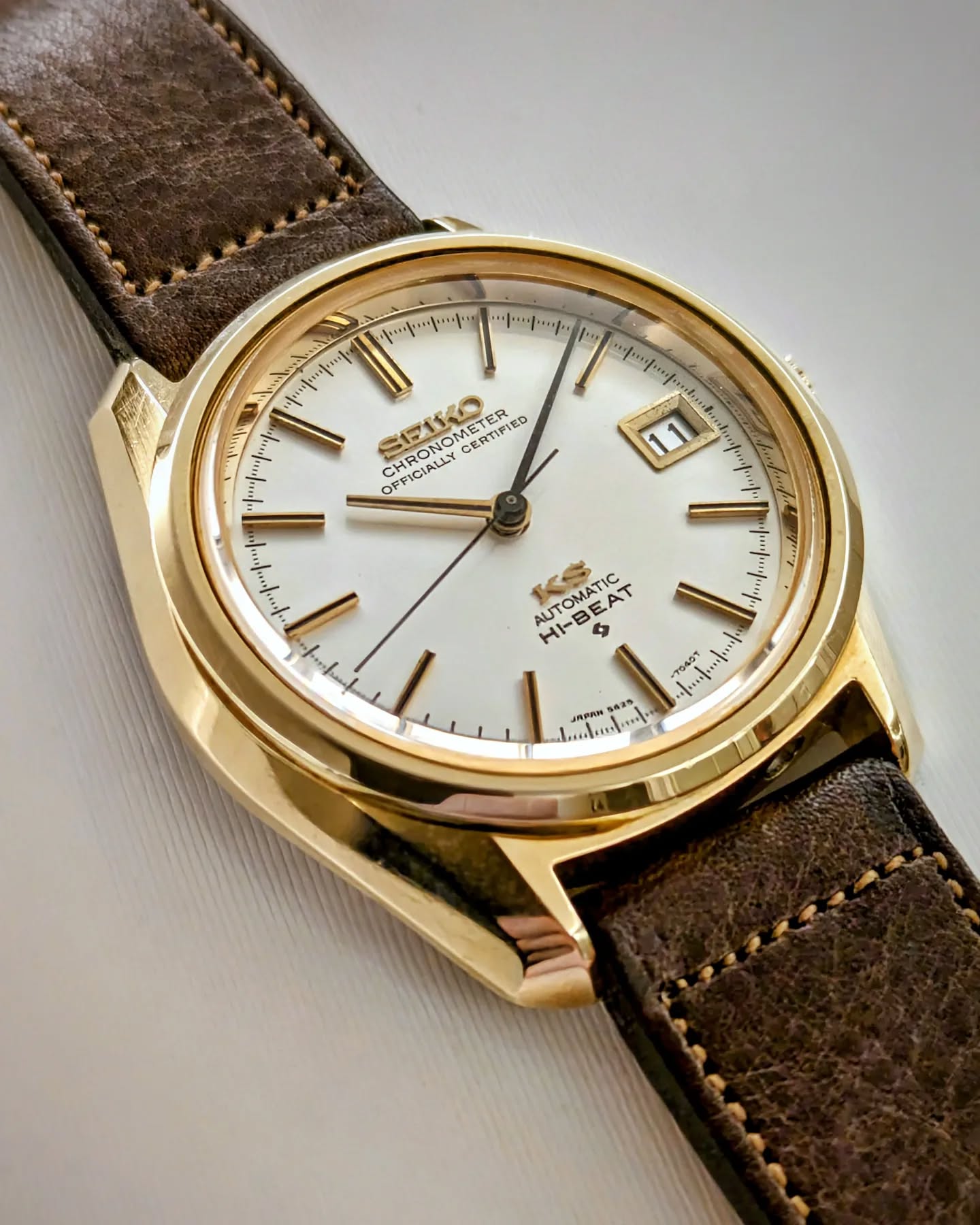
A familiar shape, transformed
The gold hue changes this familiar 56KS outline far more than I expected. A watch that can seem almost everyday in steel becomes remarkably warm and present on the wrist, without needing a different vocabulary of lines.
What matters is that the edges remain precise. On this September 1971 example, the warmth of the material never softens the definition of the case. Light gathers on the polished surfaces and stops decisively at their boundaries.
An uncommon face of the 7040
Steel is the familiar face of this design. The cap-gold 5625-7040 is a much less usual encounter; when I first showed this example, its rarity was part of the surprise. What held my attention was how thoroughly the warm material transformed such a recognisable shape.
The pleasure continues on the wrist. This example arrived beautifully serviced and regulated, with remarkably crisp edges. Its appeal lies as much in that definition and ease of use as in finding an uncommon version.
The watch
| Reference | 5625-7040 |
|---|---|
| My example | September 1971 |
| Family | King Seiko · 56KS |
| Manufacture | Suwa Seikosha |
| Movement | 5625 · automatic, date |
| Beat rate | 28,800 vibrations/hour · 4 Hz |
| Case | Cap gold |
| Case width, without crown | 37.1 mm |
| Thickness, including crystal | 10.2 mm |
Dimensions measured on this example.
Beside its steel relative
The steel 5626-7041 is a close relative of this cap-gold 5625-7040. They share the family’s familiar case vocabulary, with a different material and a different calendar: date only here, day and date on the 7041.
My cap-gold example measures 37.1 mm across and 10.2 mm thick, against 36.9 mm and 10.1 mm for the steel 7041. The cap-gold watch is slightly broader, as well as warmer in colour. These are measurements of two complete specimens; they do not by themselves establish how much of the difference comes from the gold cap.