
About The Tanaka Line
The name behind the line
The name on the dial is Seiko. The name I want to keep in view here is Taro Tanaka.
In his 2004 account, Tanaka remembers comparing watches at Wako in 1962. The Swiss pieces caught the light; Seiko’s reflections were uneven. He made the shape and finish of each surface part of a common design language: broad planes, simple supporting curves and polishing that would hold a clean reflection. He describes watching customers respond and revising the designs over time.
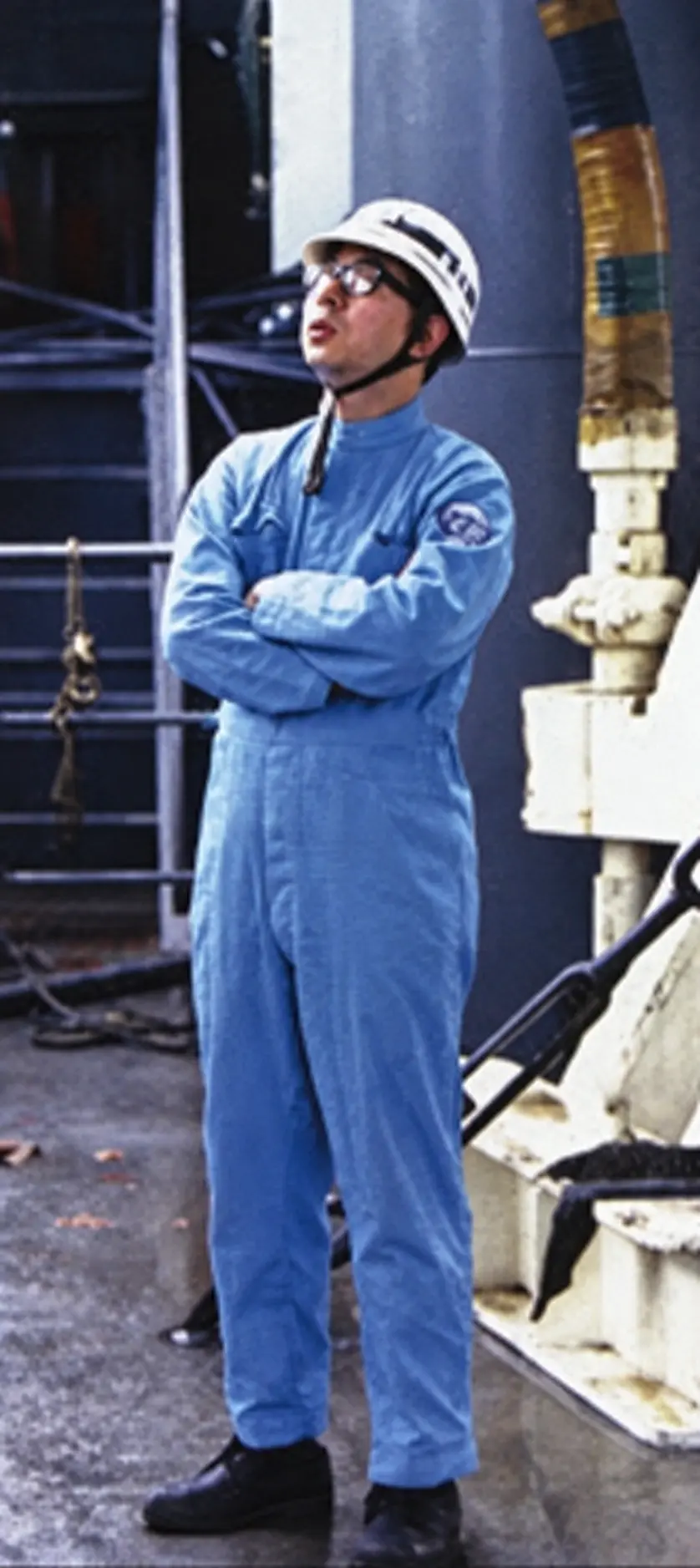
I like seeing him here in protective gear. In the Seiko Museum’s account of the Professional Diver’s 600m, Tanaka describes visiting a drillship at Kure with an engineer, listening to the professional divers and seeing their equipment. It is a different chapter from these King and Grand Seikos, but the habit is recognisable: listen, look, test, and let the conditions of use shape the answer.
Tanaka himself reaches beyond watchmaking. He writes about the changing light and shade on fans, folding screens and sliding partitions: simple constructions capable of many expressions. Reading this, I recognise a concern that runs through his watches. Their geometry stays still while their appearance changes with the light. The connection to Japanese visual culture is one he makes himself.
His account also extends into the hand. He cares about the movement of a seconds hand, the feel of setting the time and the behaviour of the calendar. He asks whether a watch can retain its value as time passes and its performance is surpassed. That breadth matters to me. It describes an ambition for the complete object, experienced and lived with over many years.
Giving Tanaka his place also means taking his team seriously. He describes the contribution of case makers and the work required to turn a design language into production. A shared language can carry a designer’s thinking into work developed by others.
Yet the person can become surprisingly difficult to see in the finished brand story. Grand Seiko’s own account of its design language describes the designer’s observation at Wako and the choices that followed, but leaves him unnamed. I want to keep that human contribution visible: the act of looking, the judgement, the repeated decisions through which a recognisable way of designing emerges.
The Tanaka Line follows that thinking through the watches. The line is a drawn edge, a relationship between designs, and a way of looking that continues to give me pleasure. Its name is a small, deliberate act of recognition.
A collector’s eye

I’m Axel, an architect and collector of vintage King Seiko and Grand Seiko. I came to these watches through their shapes. Photographing and comparing them has become an ongoing study of the decisions behind their surfaces, edges and proportions. I share those observations on @thetanakaline.
My interest in Dom Hans van der Laan has helped me look at those relationships more carefully. When I place Tanaka in the same conversation as Mies van der Rohe, what I recognise above all is form allowed to be itself. Its force comes from the relationships between planes, edges, proportions and light, without needing an anecdote or an analogy to make it compelling. That is the abstraction I respond to.
Unless otherwise credited, all photographs on this site are my own.
Questions or thoughts? Write to me at thetanakaline@gmail.com.
Sources and perspective
The photographs and visual comparisons come from my collection and the ongoing studies shared on @thetanakaline. Earlier posts explore the case fold, marker rhythm and proportion and Van der Laan. The comparison with Mies and my preference for the steel 44GS are personal judgements.
The historical account draws on Taro Tanaka’s own retrospective: “The Most Excellent Product of Seiko: Grand Seiko”, The Horological International Correspondence, May 2004, pp. 88–95. Page 90 describes Wako, the surface principles and their revision; p. 93 discusses collaboration with case makers; p. 95 addresses handling, Japanese screens and lasting value.
The Seiko Museum Ginza’s account of the Professional Diver’s 600m includes Tanaka’s portrait and describes his visit to the drillship at Kure. The displayed portrait is digitally enhanced from a small reproduction; fine details are interpretive.
The observation about the unnamed designer concerns Grand Seiko’s design-language page and Why Zaratsu polishing?. It does not establish why he is unnamed there.