
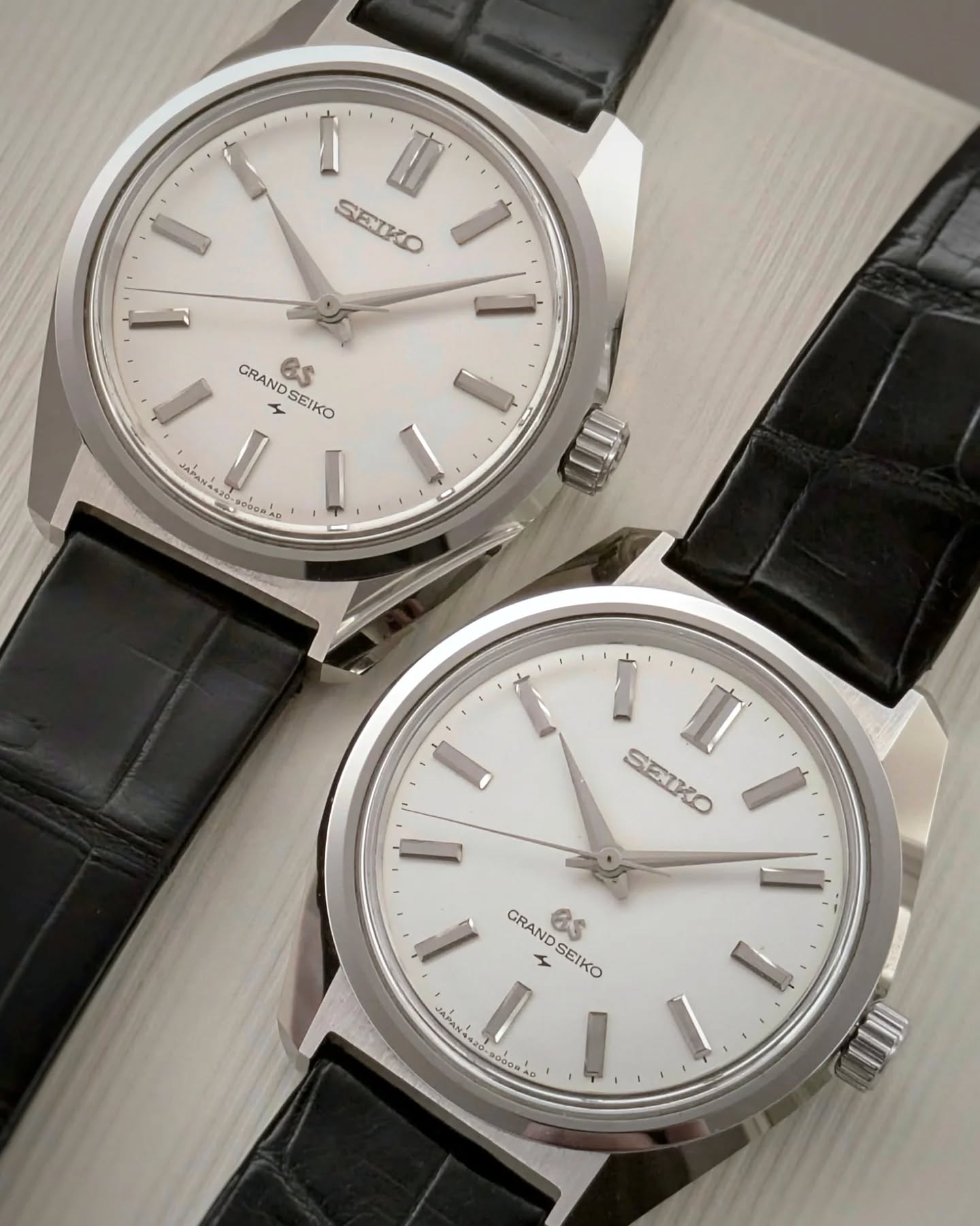
The steel 44GS has a strange quality. The longer I look at it, the less it appears to be trying.
This is rather remarkable, because there is nothing particularly simple about its design.
The case is an intricate arrangement of curved surfaces, straight edges and sharply inclined planes. Its geometry is assertive, its proportions carefully judged, its surfaces polished to an almost unreasonable degree. And yet the result is extraordinarily calm.
It is a complicated object that refuses to look complicated.
In the Origin Story, I traced what I see as the path Tanaka and his team took towards the 44GS. Here, I am trying to put into words why the finished watch matters so much as a work of design. That conviction arrived almost immediately, long before I could explain it.
At the heart of that first impression was an unexpected wholeness: crystal, bezel, case and lugs did not appear as separately designed parts, but as a single sculptural movement.
Consider its geometry.
On a conventional watch, the bezel sits on a case, the lugs project from it, and the strap is attached between them. On the 44GS, those junctions become part of the design itself. The strongly articulated lugs are drawn into a continuous fold across the case flank. The bezel remains distinct, but its junction belongs to that same movement, while the straight edge between the lugs leads naturally to the strap. Curved surfaces meet straight lines and inclined facets, not as a display of competing geometries, but as different inflections of one shape.
Nothing is dissolved into shapelessness. Every element remains legible, but none insists on being understood independently.
The result is singularly inventive, yet leaves the familiar archetype of a wristwatch completely intact. Everything is still recognisable. Nothing is quite as it was.
That is quite a trick.
Then there is the light.
Much has been said about the brilliant polishing of Grand Seiko watches. But brilliance is only half the story.
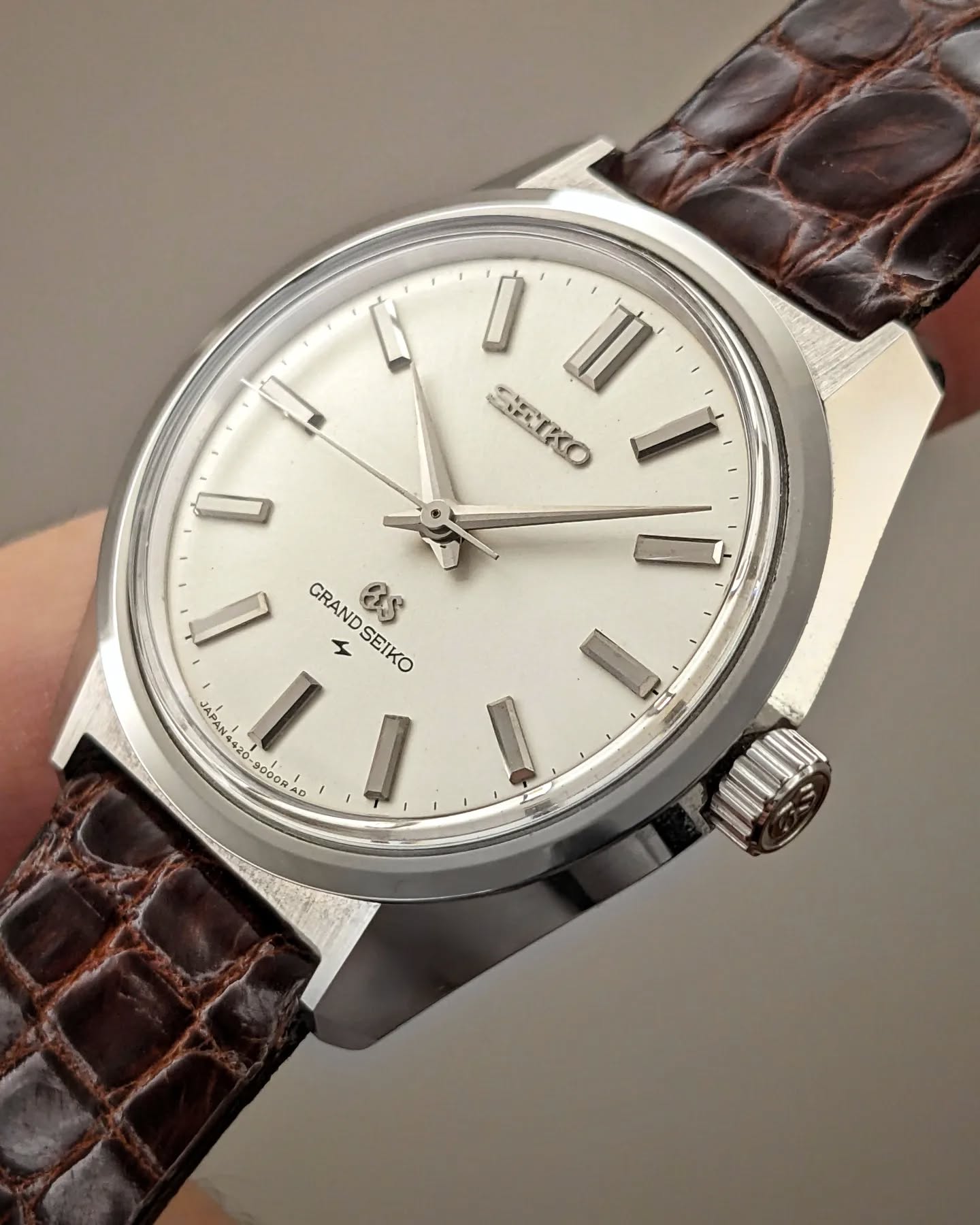
What fascinates me about the 44GS is its equal command of darkness. Its polished facets don't simply reflect light; they also disappear into deep, almost black planes as the watch moves. The crisp boundaries between those opposing conditions make its geometry unusually tangible and present.
The shadows are not a by-product of the reflections. They confirm the volumetrics and are just as essential to the design.
And so the watch manages to be both highly articulated and remarkably unified. Completely devoid of contingency and ornament, its richness comes entirely from the form itself. Nothing has been added to entertain the eye or explain what the shape is meant to represent.
It is simply form, doing what form does best.
The dial has its own, almost architectural monumentality. The indices stand in a generous, unmistakable rhythm. Each has its own presence, and the spaces between them matter just as much as the metal. The effect is of an order far larger than the object that carries it.
As an architect, I find myself returning to the work of Dom Hans van der Laan, particularly his investigations into the relationships between dimensions and the character of volumes.
In his morphotheque, plates, bars and blocks possess quite distinct formal identities. Between these more singular types are what he called blank forms: objects whose proportions allow different volumetric characters to coexist.
What interests me in this comparison is not a mathematical correspondence between his system and the 44GS. It is the more general idea that a form can become richer, rather than weaker, by reconciling different kinds of expression.
I see something similar in the 44GS.
Its curves need the straight lines that contain them. Those lines acquire their force from the inclined planes that meet them. The polished surfaces need the shadows. The sculptural case needs the precisely measured architecture of the dial.
And all these relationships depend on proportion.
The width of the bezel, the diameter of the dial, the extent of the hands, the lengths and volumes of the indices, the apparent lengths of the lines where the case surfaces meet: each is a distinct measure, but none seems to belong to a different order.
Nothing appears exaggerated to make a point. Nothing feels timid or unresolved.
The whole arrangement possesses a kind of relaxed inevitability.
Which is perhaps the most difficult part.
The ruthless abstraction and deceptive simplicity of the 44GS leave nowhere for an uncertain line, junction or proportion to hide. At the same time, the work required to refine any one of them can seem absurdly disproportionate to its visible effect. The more effortless the result, the harder it is to appreciate what it took to get there.
I cannot know what resistance Tanaka and his team encountered during its development. But I recognise the extraordinary conviction expressed by the finished object. There is nothing tentative about it. The smallest relationships have been carried through with the same resolve as the largest.
And once they are resolved, the labour disappears from view.
For me, the 44GS is one of those rare watches in which all the stars align. Its movement is no exception.
The manually wound 4420B feels like a gloriously overengineered little machine. Its broad crown, firm resistance and powerful, spring-loaded clicks lend winding the sensation of cocking a miniature medieval catapult. There is a wonderfully deliberate precision to every turn, almost absurdly substantial for something so small. And then there is its steady 2.5 Hz rhythm, as natural and reassuring as the beating of our own hearts.
All of these things matter to me. A watch is not merely something to look at. It is something we handle, wind, wear and live with.
And this one feels as coherent in use as it does in appearance.
Perhaps that is why I find the 44GS so difficult to improve upon, even in imagination.
It isn't that every feature is pushed to some spectacular extreme. Quite the opposite. Its achievement lies in the extraordinary balance between them. Change one relationship and I suspect the effortless quality of the whole would begin to unravel.
I tend to think that this is characteristic of the most enduring classical designs. Their richness comes not from the accumulation of individual virtues, but from the way those virtues become mutually necessary.
Nothing needs to announce its importance. Nothing needs to explain itself.
The remarkable thing about the 44GS is not that everything is so carefully resolved.
It is that nothing seems to need resolving.