
King Seiko 52KS 5256-8010
A late, clear line
The 5256-8010 has a sparer expression than the earlier 52KS watches here. The dial lettering is reduced, the case lines are taut, and the lugs carry a strong fold towards the strap. There is a little more width to work with, too: both of my examples measure 35.8 mm.
The steel and gold-plated versions share the reference and measured proportions, but the dial finishes give them different characters. They deserve to be looked at separately.
Steel and sunburst
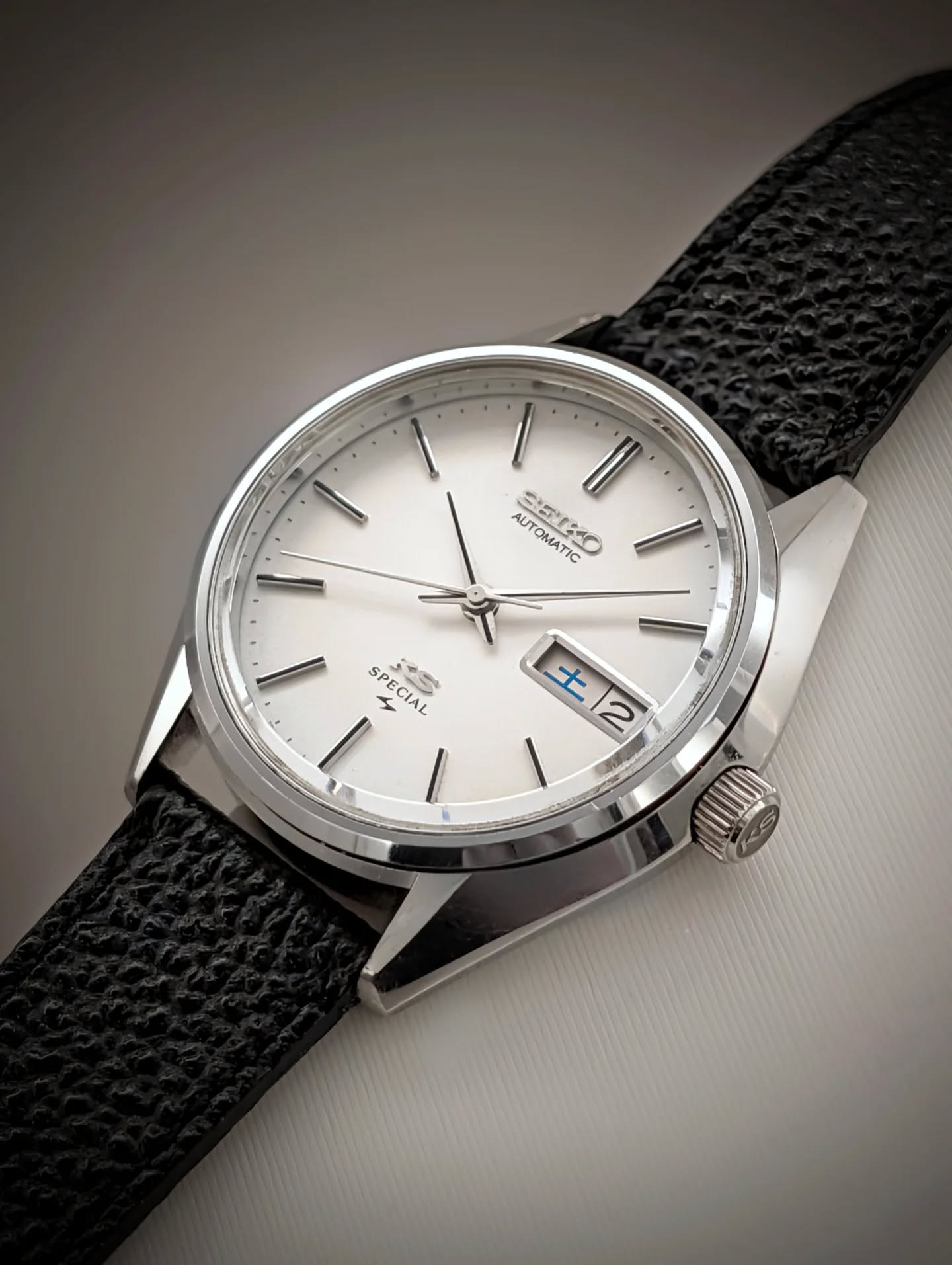
The April 1975 steel example makes the case geometry particularly easy to follow. Broad brushed surfaces meet narrow polished edges, and the sunburst dial continues the movement of light towards the perimeter.
The uncluttered printing gives the face a more relaxed rhythm than the earlier chronometer dials. The long markers and the day-date frame do most of the work. The larger crown is also a welcome part of the handling of this compact automatic.
Finding the face
The dial sits deep enough for the inner wall to become a strong part of the composition. Photographing it can be surprisingly awkward: light that opens up the dial often leaves the flanks in shadow. The case has more depth than its restrained outline first suggests.
My steel example was also held back by a cloudy crystal. In 2022 I replaced it with an original replacement part supplied with its bezel. The clearer view brought back the separation between hands, markers and the silver sunburst beneath them.
The watch
| Reference | 5256-8010 |
|---|---|
| My example | April 1975 |
| Family | King Seiko 52KS |
| Manufacture | Daini Seikosha |
| Movement | 5256A · automatic, day and date |
| Beat rate | 28,800 vibrations/hour · 4 Hz |
| Case | Stainless steel |
| Case width, without crown | 35.8 mm |
| Thickness, including crystal | 10.0 mm |
Dimensions measured on this example.
Gold and linen
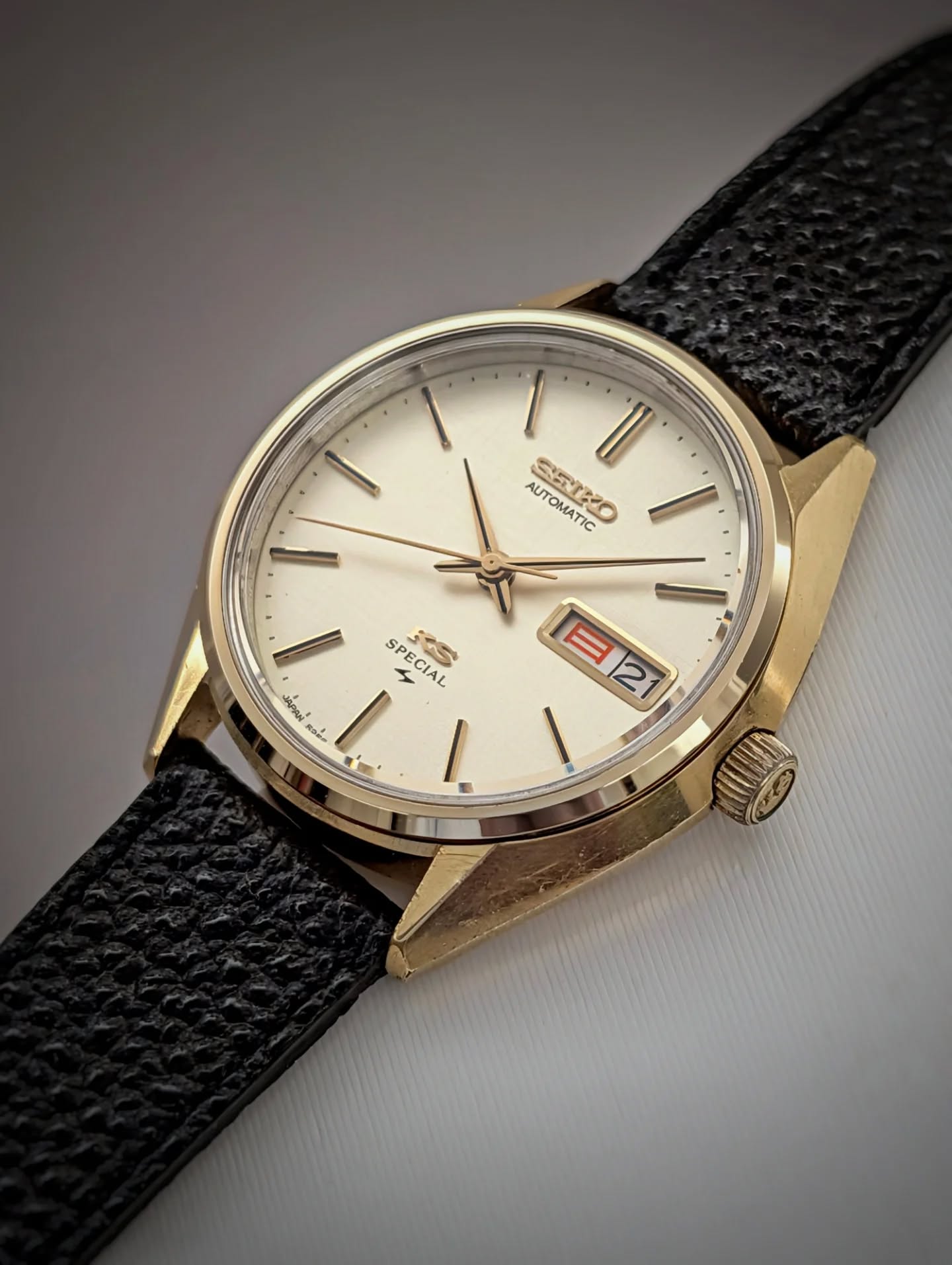
The March 1975 SGP example wears its history more openly. It came to me neglected, with a winding and setting action that felt alarmingly coarse. Service revealed no damage and returned it to comfortable use.
Its light-gold linen dial can look paler than the case in one photograph, then take on almost the same tone at another angle. That can make the whole watch feel like one continuous golden object, with the black marker accents supplying the necessary definition.
The plating is visibly less forgiving of use than the steel case beside it. I find the remaining sharp folds and the worn surfaces persuasive together; the watch has kept its shape without pretending to have escaped a working life.
| Reference | 5256-8010 |
|---|---|
| My example | March 1975 |
| Family | King Seiko 52KS |
| Manufacture | Daini Seikosha |
| Movement | 5256A · automatic, day and date |
| Beat rate | 28,800 vibrations/hour · 4 Hz |
| Case | SGP · gold-plated |
| Case width, without crown | 35.8 mm |
| Thickness, including crystal | 10.0 mm |
Dimensions measured on this example.
The altered balance
The 5256A movement is thicker than the earlier 5245A and 5246A: 4.20 mm against 3.95 mm in Seiko’s technical sheets. The complete watches remain compact at 10.0 mm including the crystal.
That mechanical change belongs in the account, but it does not explain every decision outside it. The quieter dial, the cut of the lugs and the choice of surface finish need to be read on their own terms.