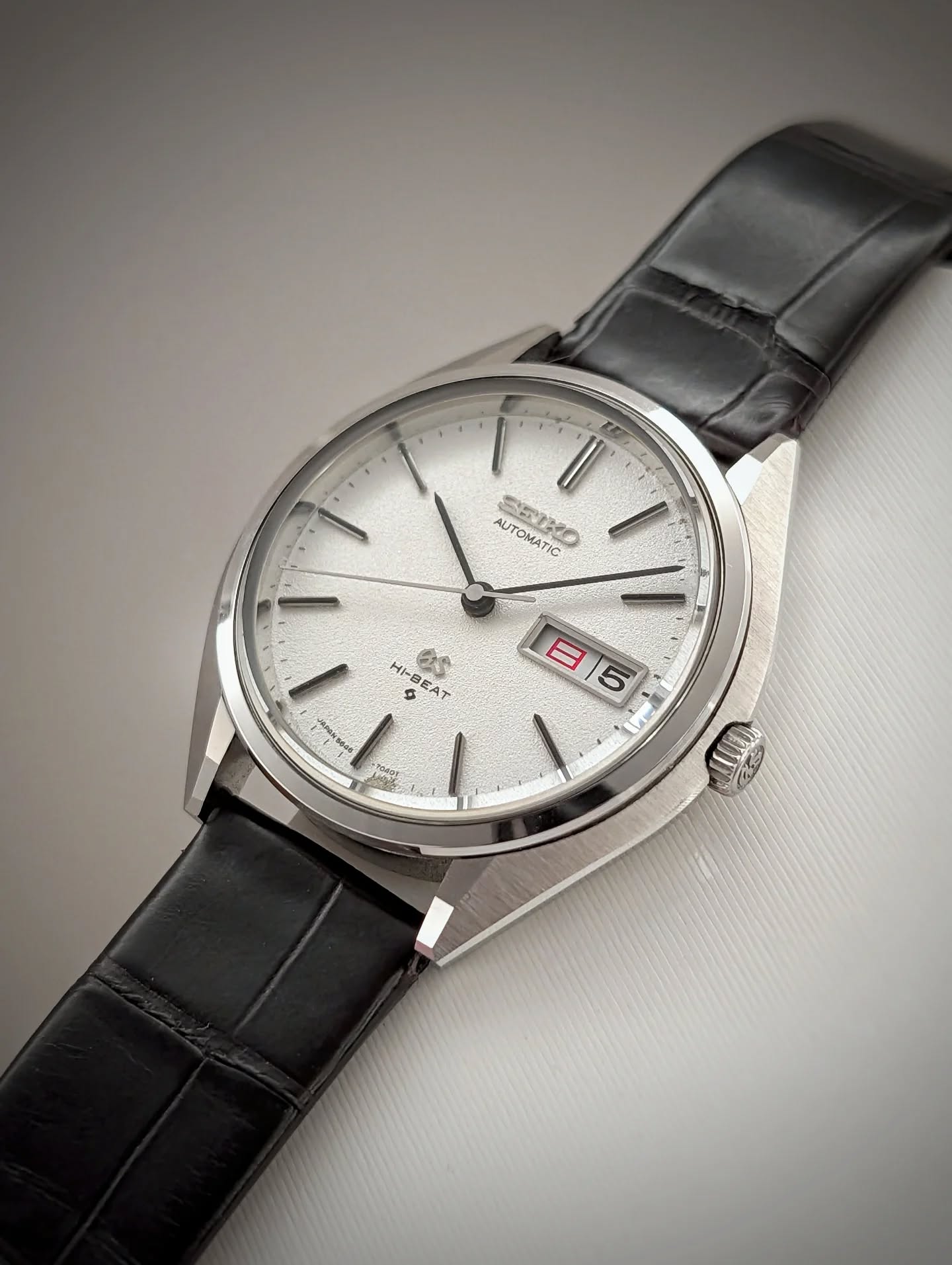
Grand Seiko 56GS 5646-7030
Not quite the familiar one
At a casual glance the 7030 can disappear among the more familiar 7010-shaped watches. In the hand it becomes a different proposition. The bright frosted dial is enclosed by a case full of small, tightly controlled facets, ending in a surprisingly narrow 17 mm strap opening.
The flat facet along the case edge is echoed by the bezel. Together they give the watch a coherent, stacked quality. That narrow boundary also frames the brushed case top; without it, the surface would read quite differently.
Restoring the distinction
My December 1973 example had lost much of that definition before Kamil at Lapinist restored it. The difficulty is not simply making an edge sharp. It is recovering the proportions and the boundaries between several adjacent polished planes.
The result made the design legible again. I keep returning to the sideways brushing, the small turns of the lug surfaces and the way each catches the light on its own terms.
The watch
| Reference | 5646-7030 |
|---|---|
| My example | December 1973 |
| Family | Grand Seiko · 56GS |
| Manufacture | Suwa Seikosha |
| Movement | 5646 · automatic, day and date |
| Beat rate | 28,800 vibrations/hour · 4 Hz |
| Case | Stainless steel |
| Case width, without crown | 36.6 mm |
| Thickness, including crystal | 10.5 mm |
Dimensions measured on this example.
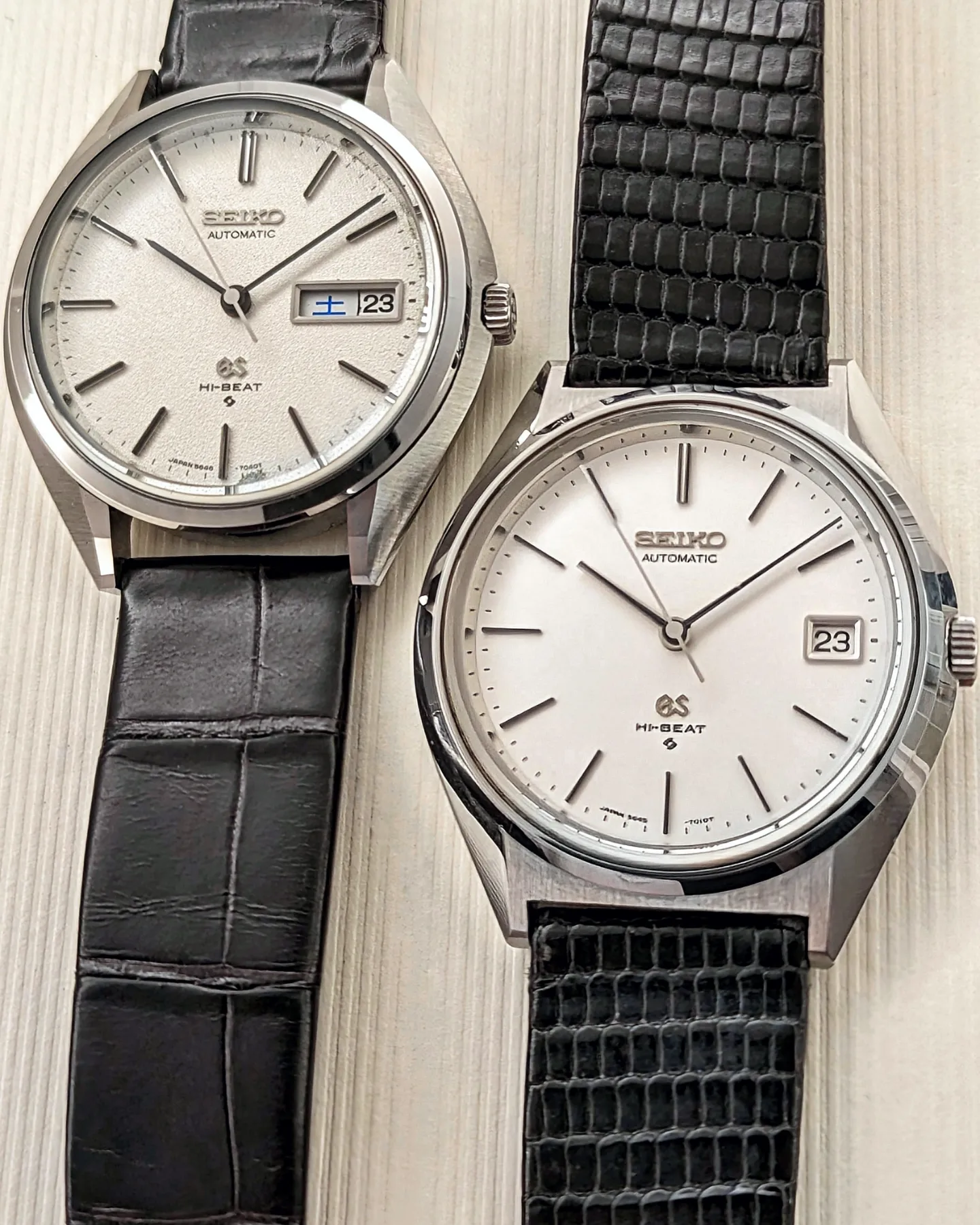
Beside the steel 7010
I once wondered why the 7030 needed to exist alongside the familiar steel 7010. Put them together and that apparent duplication disappears. The 7030 brings a frosted dial and a more intricate sequence of facets; the 7010 has a sunburst dial and a broader, calmer flow from bezel to lugs. Similar at first glance, they become quite distinct once those surfaces begin to catch the light.