
Grand Seiko 56GS 5646-5010
Learning to look again
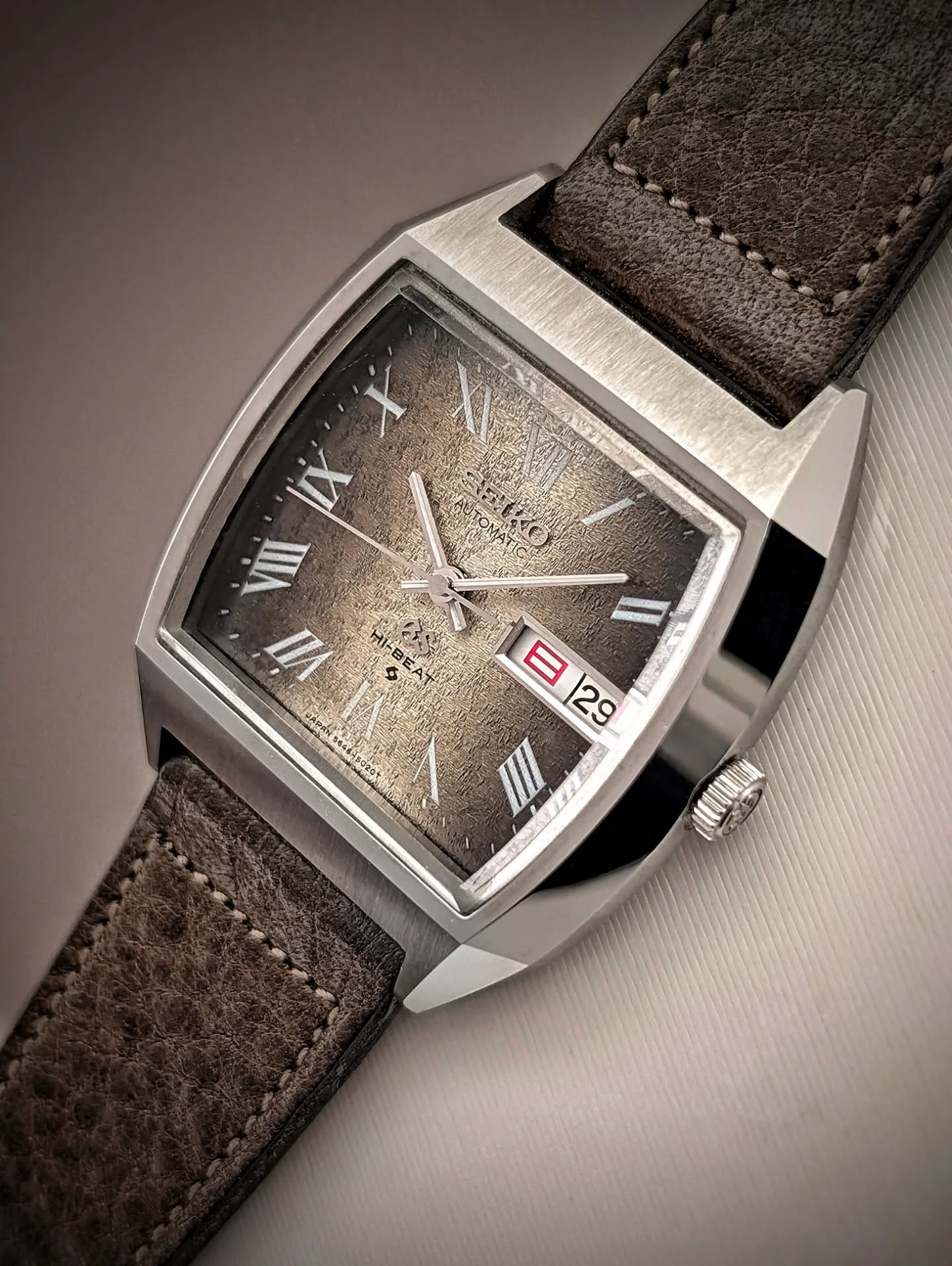
I initially dismissed the 5010 as an experiment too far outside the Grand Seiko language. The tonneau shape seemed too eclectic, and the Roman numerals only made that first judgement more severe. Handling the watches changed my mind.
The case is a cascade of folds and alternating brushed and polished surfaces. At the four corners of the crystal, the straight folds release into the meeting of the brushed surfaces at the lug ends. However often I look at it, I still find that geometry difficult to hold in my head.
A living surface
The brown dial makes the experience still more complex. Its texture and graduated colour give it a life that conventional photographs struggle to describe. The Roman numerals establish a different rhythm from the raised stick markers I usually associate with these watches.
There is a trade-off. At some angles the texture seems to camouflage the hands, and without the usual three-dimensional markers the dial can briefly feel much emptier. I love the watch all the more for what that reveals about the importance of those small volumes elsewhere in the range.
Beyond the first impression
For all its unusual angles, the 5010 sits naturally and comfortably on the wrist. My June 1972 example became a particular favourite after its case restoration by Kamil at Lapinist brought the tension between the surfaces back into focus.
This is a reference that taught me something about collecting: go your own way, but leave enough room to revise your judgement.
The watch
| Reference | 5646-5010 |
|---|---|
| My example | June 1972 · brown dial, Roman numerals |
| Family | Grand Seiko · 56GS |
| Manufacture | Suwa Seikosha |
| Movement | 5646 · automatic, day and date |
| Beat rate | 28,800 vibrations/hour · 4 Hz |
| Case | Stainless steel |
| Case width, without crown | 35.0 mm |
| Thickness, including crystal | 10.1 mm |
Dimensions measured on this example.
Blue dial, stick markers
The blue-grey version was my first way into this case design. Its raised markers bring back the familiar rhythm of the Grand Seiko dial, while the deeply recessed display makes the folded case feel even more substantial.
The blue shifts towards grey and sometimes purple in the light. With the same measured width and thickness as the brown example, it offers a particularly direct way to see how much the character of a watch resides in its dial.
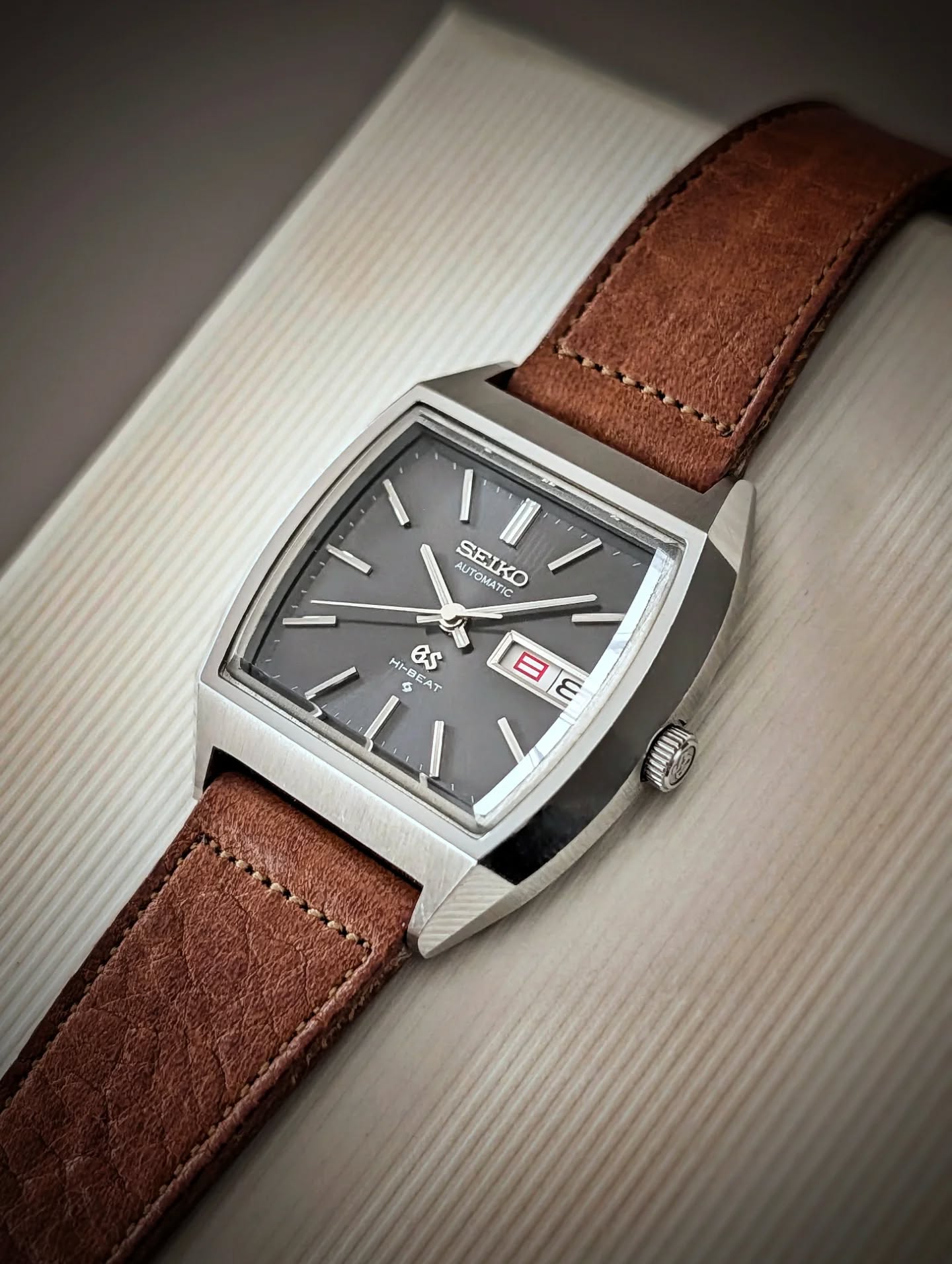
| My example | July 1972 |
|---|---|
| Case | Stainless steel |
| Dial | Blue · stick markers |
| Case width, without crown | 35.0 mm |
| Thickness, including crystal | 10.1 mm |
Dimensions confirmed by the owner as matching the brown-dial example.