
King Seiko 52KS 5246-5010
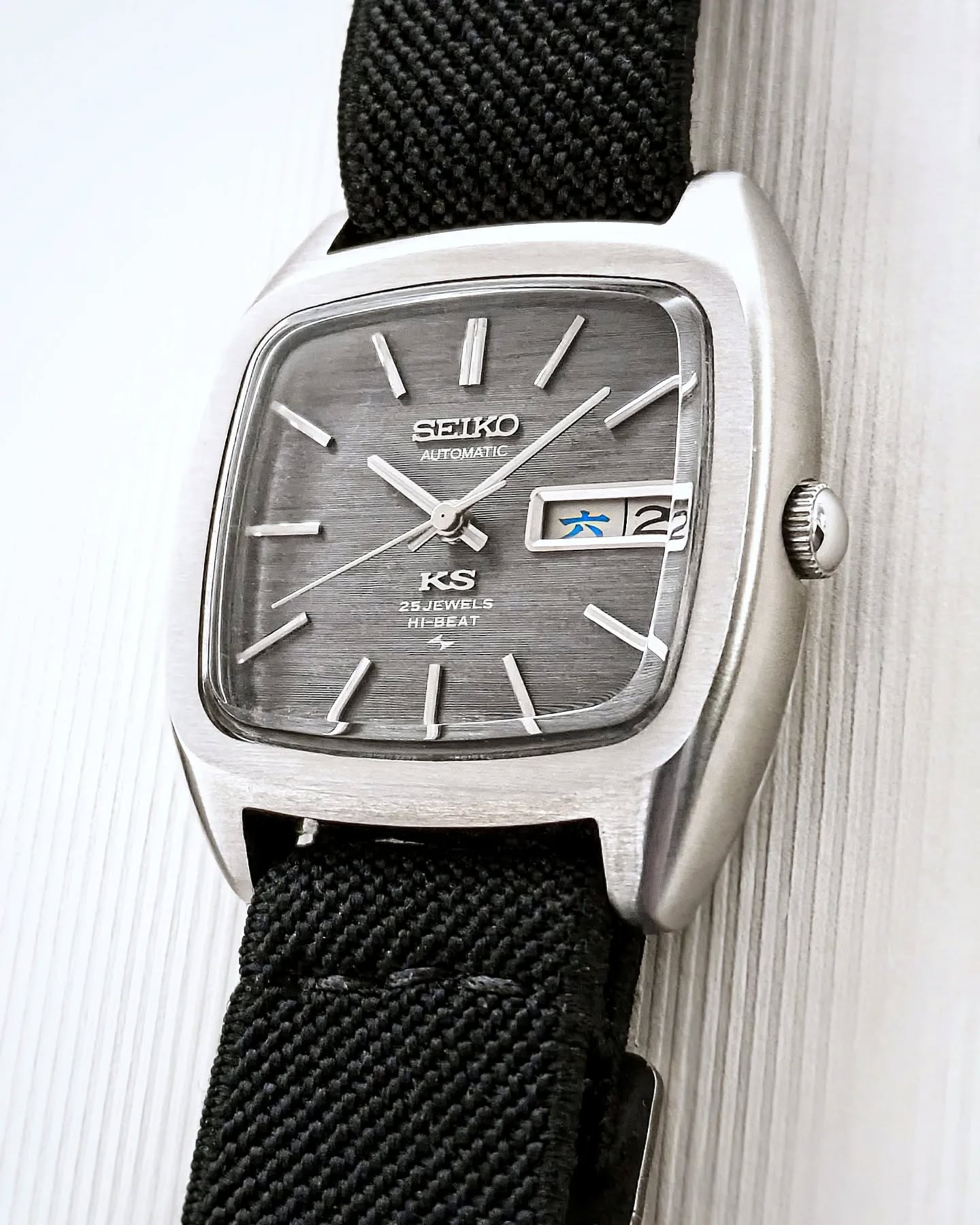
The static aesthetic
The grey dial of the 5010 has the restless surface of an untuned television. Fine, wavering grooves fill a rounded rectangular opening, with no minute track to contain them. The hour markers seem to hover above it.
The case follows the same television-like outline. Its broad brushed surfaces and 20 mm strap opening give this 35.6 mm watch a presence that its width alone does not explain.
An unusually open face
There is no enclosing ring of minute marks, and the textured dial reaches right up to its frame. The change from a circular opening to this softly squared one gives the markers a different rhythm: more space at the corners, tighter relations along the sides.
The lettering is restrained, too. The applied KS emblem and the small text beneath it sit comfortably in the lower half. The day and date supply a compact block on the right, rather than dominating the composition.
A different calendar
This example has English and Chinese day indications. That is a specific detail of the watch in front of me; it is also part of what first made the 5010 stand apart from the familiar Japanese-market 52KS references.
Its appeal does not depend on an elaborate backstory. The grooved grey dial, broad strap and brushed case already give it a very particular character.
The watch
| Reference | 5246-5010 |
|---|---|
| My example | June 1972 |
| Family | King Seiko 52KS |
| Manufacture | Daini Seikosha |
| Movement | 5246A · automatic, day and date |
| Beat rate | 28,800 vibrations/hour · 4 Hz |
| Case | Stainless steel |
| Case width, without crown | 35.6 mm |
| Thickness, including crystal | 9.5 mm |
Dimensions measured on this example.